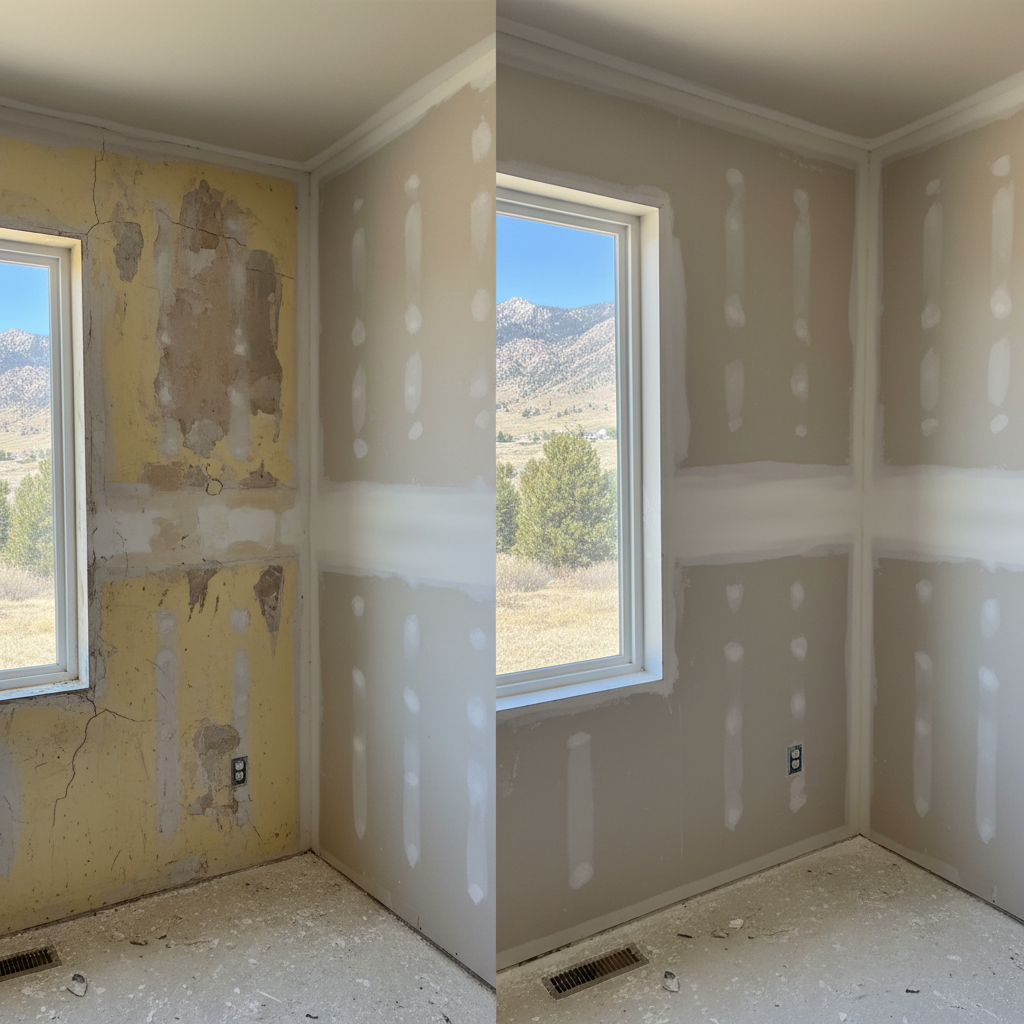
So, you're tackling a big drywall project, right? Maybe a new addition, or a major renovation. You've got the sheets, you've got the tools – or you're thinking about calling in a pro like us. One question always comes up, and it's a good one: how exactly should those sheets go up on the wall? Do you run them horizontally, like siding, or vertically, from floor to ceiling? It’s not just some random choice; there are real differences that impact the final look and feel, especially here in Millcreek.
Horizontal Drywall Hanging: The Usual Way
Most of the time, when we're hanging drywall, we go horizontal. That means the long side of the sheet runs parallel to the floor. Picture it like laying bricks, but with big, flat panels instead.
Why It's So Common:
- Fewer Butt Joints: This is a huge deal. When you hang horizontally, the tapered edges of the drywall sheets meet up. These tapered edges are made to be easily feathered out with joint compound, giving you a smoother, practically invisible seam. Sure, you'll still have some butt joints (where the non-tapered ends meet), but usually fewer of them. Plus, they're often higher or lower on the wall, out of direct sight.
- Easier to Handle: A 4x8 or 4x12 sheet is just plain easier to lift and move around horizontally, especially if you're working alone or with only one helper. You can even rest the bottom edge on a block or a drywall lift, then just pivot it into place.
- Stronger Walls: Running sheets horizontally often means they cross more studs. This can make the wall assembly a bit stronger, which helps prevent cracks over time. In places like Millcreek, where we get our share of seismic activity, even small structural benefits are worth thinking about.
- Less Waste: For standard 8-foot ceilings, using 4x8 sheets horizontally usually means less cutting and, you guessed it, less waste. You're mostly just cutting the sheets to fit the wall's length.
The Downsides:
- More Seams to Finish: While those seams are easier to finish, you generally have more linear feet of them when hanging horizontally, especially in taller rooms.
- A Little More Work for Taller Walls: If your walls are taller than 8 feet, you'll need two rows of drywall. That means an extra horizontal seam to finish.
Vertical Drywall Hanging: When It Makes Sense
Vertical hanging means the sheets go straight up and down, from floor to ceiling. It's not the go-to for most wall surfaces, but it definitely has its moments.
When to Think About It:
- Really Tall Walls (9+ feet): If you've got super tall walls, say 9 or 10 feet, using 4x10 or 4x12 sheets vertically lets you cover the whole height with a single sheet. This gets rid of that extra horizontal seam you'd have with horizontal hanging, which can really save time during the finishing stage.
- Narrow Walls or Alcoves: For small, tight sections of wall, like in a pantry or an alcove, a single vertical sheet might cover the whole area with hardly any cutting. That simplifies the job.
- Fire-Rated Assemblies: Sometimes, specific fire-rated wall setups actually require vertical hanging. This isn't usually a homeowner's decision, of course, but it's a code thing we deal with.
The Downsides:
- More Butt Joints: This is the biggest problem. When you hang vertically, the 4-foot ends of the sheets meet up. These are the non-tapered, factory-cut edges, and they are notoriously harder to finish smoothly. You'll end up with more butt joints, which need more mud and more careful feathering to hide. If they aren't done perfectly, these can show up as subtle humps or ridges, especially under certain lighting.
- Harder to Handle: Trying to lift a 4x10 or 4x12 sheet vertically, especially by yourself, is a lot tougher. Gravity just isn't on your side here. It's also more likely to break or bend.
- Less Efficient for Standard Heights: For standard 8-foot ceilings, hanging 4x8 sheets vertically means you'll have a lot of wasted material if your wall lengths aren't perfect multiples of 4 feet.
Cost, Durability, Upkeep, and How It Looks
Let's break down how these two methods compare in the areas you probably care about most.
- Cost: For most typical residential projects here in Millcreek, horizontal hanging usually ends up being more budget-friendly. Fewer difficult butt joints mean less labor for taping and mudding, and less material (joint compound). If you're hiring a pro, less labor time means a lower bill. Vertical hanging *can* be cheaper for very tall walls if it lets you skip a full horizontal seam, but that's a pretty specific situation.
- Durability: Both methods give you durable walls if they're installed correctly. But, like I said, horizontal hanging often means the sheets span more studs, which can offer a slight edge in structural integrity and help resist minor cracking over time. The biggest factor in durability, though, is really the quality of the framing and the finishing work, not just which way the sheets are hung.
- Maintenance: This mostly boils down to how well the finish was done. A poorly finished butt joint from vertical hanging will be more likely to show cracks or imperfections later on than a nicely finished tapered joint from horizontal hanging. So, for long-term upkeep, horizontal generally gives you an easier, more stable finish.
- Appearance: This is where horizontal hanging truly shines for most homes. The whole point of drywall is to get a smooth, seamless wall. Because horizontal hanging minimizes those hard-to-hide butt joints and maximizes the easy-to-hide tapered ones, it almost always results in a better, flatter look. Those subtle humps from butt joints on vertical installations can be a real pain to hide, especially when you have critical lighting – like a window washing across the wall.
My Recommendation for Millcreek Homeowners
For the vast majority of homes here in Millcreek, whether you're in a classic rambler near Highland Drive or a newer build up by Olympus Cove, I strongly recommend **horizontal drywall hanging** for your walls. It's the standard for a reason, you know?
It gives you a better-looking finish, is generally more efficient for standard ceiling heights, and means fewer headaches during the finishing process. The only real exception is for walls that are significantly taller than 8 feet; there, using full-height sheets vertically might eliminate a horizontal seam and be more efficient. Even then, you're just swapping one type of seam for another, and those butt joints are always tougher.
When Guardian Drywall Solutions shows up for a job, unless there's a specific reason or a code requirement, we're hanging those sheets horizontally. It's simply the best way to make sure you get the smooth, durable walls you're paying for. Don't overthink it; stick with what works best.